

Futuremark ist bekannt für jegliche Benchmark-Programme, so auch für das "Benchmark Development Program". Nun ist auch Bitboys, die für ihre Grafikchips in Handys und PDAs bekannt sind, als Unterstüzung beigetreten. Neben ATi, Imagination Technologies (PowerVR), Intel, Khronos Group, Neomagic, und Nvidia ist Futuremark sehr froh einen weiteren Partner zur Seite zu haben.
"We are delighted that Bitboys joined our Smartphone Benchmark Development Program. They will greatly add value to the program that consists of leaders of the mobile graphics industry and whose objective is to provide customers with objective, certifiable performance evaluations of their technology," said Tero Sarkkinen, Executive Vice President of Sales and Marketing for Futuremark. "We hope and expect that Bitboys will play a key role in the further development of Futuremark´s suite of benchmarks aimed at mobile applications, which will provide an excellent opportunity for Bitboys to showcase the capabilities of its new Acceleon(tm) mobile graphics solutions."
Das Smartphone Benchmark Programm, soll die "Grafikchips" von Symbian Handys und Co auf Performance und Energieverbrauch testen. Unter anderem werden OpenGL ES API 3D Spiele Szenen dargestellt und es wird gemessen, wie schnell das Handy Bilder "verarbeiten" kann. Das Programm soll circa im zweiten Quartal 2004 fertig sein.
KIOXIA hat mit der LD4-Serie seine ersten SSDs im E1.L-Formfaktor auf Basis der achten Generation des BiCS FLASH QLC vorgestellt....
devolo bringt mit dem WiFi 7 BE9300 einen neuen Tri-Band-Router auf den Markt, der sich als Ethernet-Router für Glasfaseranschlüsse, Access...
BenQ erweitert seine MOBIUZ-Serie um den EX271QMZ. Der 26,5 Zoll große Gaming-Monitor setzt auf ein QD-OLED-Panel der dritten Generation mit...
Mit der E100 1 TB SSD hält Crucial eine preisorientierte NVMe-SSD mit PCIe 4.0 x4 bereit. Das M.2-2280-Laufwerk soll laut...
Im zurückliegenden Monat gab es wieder einige spannende Themen im Bereich Newsmeldungen sowie interessante Artikel und Produkttests. Folgend möchten wir...
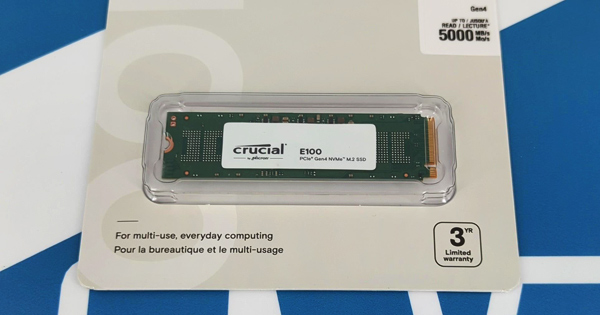
Die E100-SSD von Crucial basiert auf einem PCIe Gen4 Interface und QLC-Flashspeicher von Micron. Die Serie zielt auf Ein- und Umsteiger in die SSD-Welt ab. Wir haben uns das 1-TB-Modell im Test angesehen.
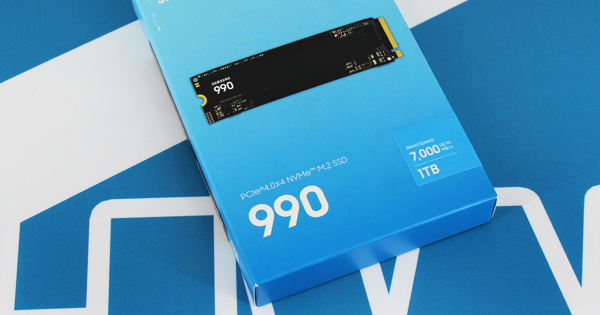
Mit der SSD-990-Familie stellt Samsung eine neue Serie von SSDs für Einsteiger vor. Wie sich die Kombination aus PCI Express Gen4 und QLC-Flashspeicher in der Praxis schlägt, klären wir am 1-TB-Modell.